Sonia Gandhi’s Memoir: The Truth Outside the Family Album
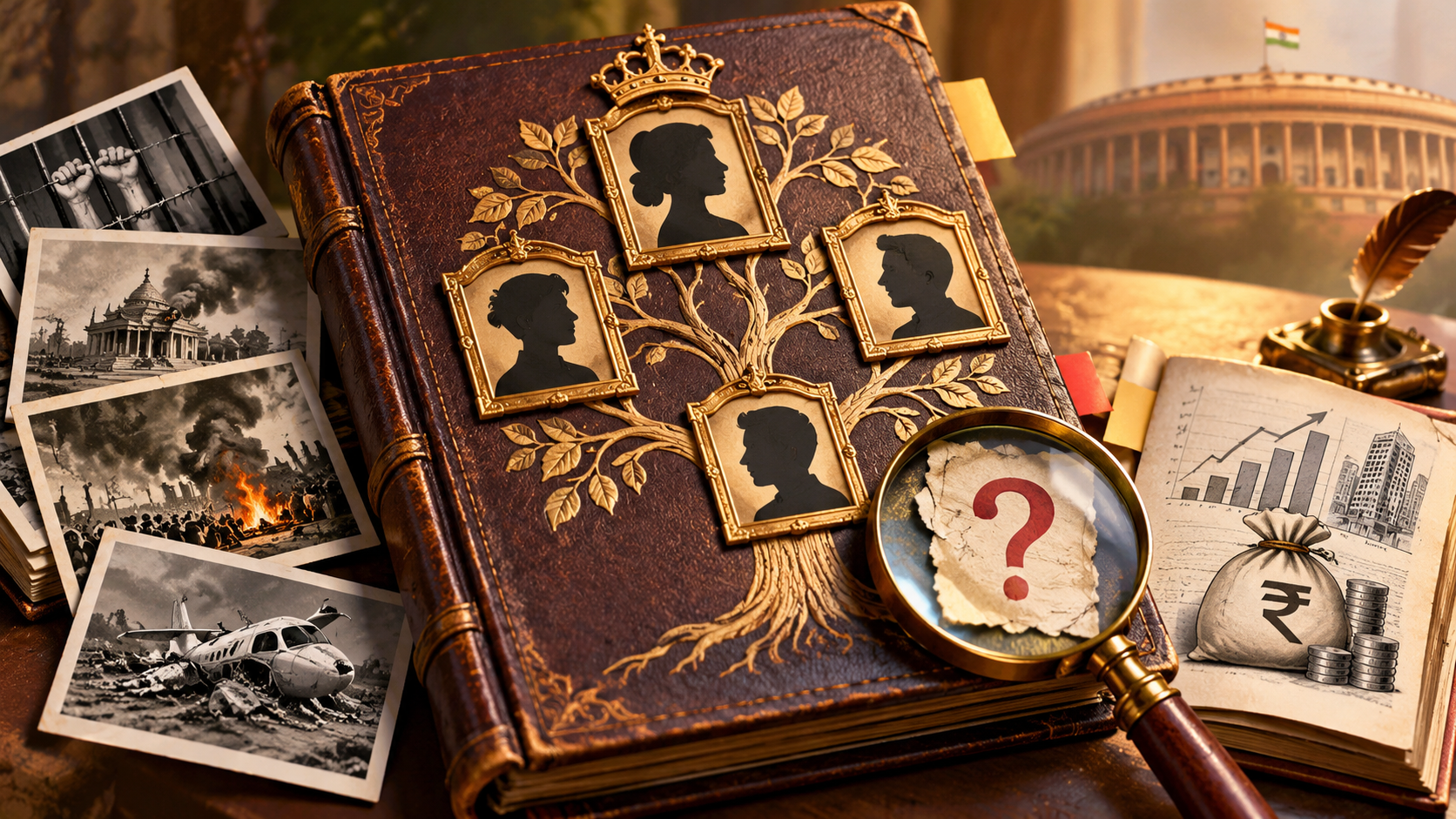
I once admired Indira Gandhi and Rajiv Gandhi. But admiration should never demand that we close our eyes to history.
There was a time when I was a great admirer of Indira Gandhi. I loved her confidence, her commanding personality and the way she represented India before the world. In a society where women were still struggling to establish themselves in public life, here was a woman who could stand before the world’s most powerful leaders without appearing intimidated. For a young Indian woman, that was something to admire.
I liked Rajiv Gandhi too. He was young, educated, charming and seemed genuinely interested in taking India towards a modern future. His enthusiasm for computers and technology appealed to my generation. I wanted to believe in the India he spoke about.
I have no embarrassment in admitting this. What would embarrass me is pretending, after all these years, that the people I admired were incapable of making serious mistakes.
And that brings me to Sonia Gandhi’s newly published memoir, Belonging: A Journey of Love.
The book tells the story of an Italian woman who married into India’s most famous political family, witnessed extraordinary tragedies and eventually became one of the country’s most influential political figures. It is certainly a life worth writing about. But the published excerpts and critical reviews of her memoir have left me thinking less about what she has revealed and more about how she has chosen to remember certain events.
A family memoir is a comfortable place to revisit history. The author chooses the photographs, the conversations, the emotions and, most importantly, the perspective. We all do this to some extent. We remember our good intentions rather more clearly than the consequences of our decisions.
In an ordinary family, selective memory might lead to an argument over Sunday lunch. In a political dynasty, it can influence how an entire nation remembers its past.
And that is where this memoir becomes more than a love story.
When Power Becomes a Family Misunderstanding
One of the interesting aspects of Sonia Gandhi’s account concerns the Emergency imposed by Indira Gandhi in 1975.
Sonia acknowledges that it was a mistake. Her account describes the pressures surrounding Indira Gandhi and the influence of Sanjay Gandhi. Rajiv Gandhi, according to the memoir, opposed the decision.
I find something rather convenient about the way political responsibility sometimes shifts in family recollections. When a leader achieves something remarkable, we celebrate their strength, vision and determination. When the same leader makes a disastrous decision, suddenly there are advisers, difficult circumstances and troublesome relatives to share the responsibility.
Indira Gandhi was powerful enough to govern India, but apparently not always powerful enough to resist her own son’s influence.
During the Emergency, opposition leaders were imprisoned, newspapers censored, civil liberties curtailed and ordinary citizens subjected to serious abuses. Forced sterilisation campaigns and demolitions left painful memories among families who had little power to resist.
Sanjay Gandhi certainly exercised considerable influence. But he was not the prime minister.
Indira Gandhi was.
The same difficulty arises when we revisit Operation Blue Star in June 1984. The government faced a serious security crisis involving armed militants, but the military operation at the Golden Temple caused deaths, destruction and lasting anguish.
Accounts of the memoir describe Indira Gandhi’s distress at the damage caused during the operation. I do not doubt her sorrow. But political history has an interesting habit of remembering the tears of those who made decisions more vividly than the tears of those who suffered their consequences.
Then came Indira Gandhi’s assassination on 31 October 1984, followed by the horrific anti-Sikh violence in which thousands were killed.
Sonia Gandhi discusses the violence and highlights Rajiv Gandhi’s appeals for peace. Those appeals deserve consideration. So does his controversial remark about the earth shaking when a great tree falls.
A grieving son deserves sympathy. A prime minister must also be judged by the government’s response to violence.
I liked Rajiv Gandhi. But liking a leader cannot mean overlooking the failures of his government.
The Deaths That Still Raise Questions
Recently, I listened to political commentator Pushpendra Kulshreshtha discussing the deaths of Sanjay Gandhi, Indira Gandhi and Rajiv Gandhi. He raised questions about investigations, security arrangements and circumstances surrounding these tragedies.
Some of those questions deserve attention. But the historical record is more interesting than the dramatic conclusions sometimes drawn from it.
Sanjay Gandhi died in an aircraft crash on 23 June 1980. The government initially announced a formal investigation under the Aircraft Rules by a Delhi High Court judge, but subsequently cancelled that arrangement. The crash was examined through the aviation investigation process.
The cancellation of the proposed judicial inquiry was discussed in Parliament. That is a documented fact, not a social media invention.
It does not establish foul play, but it is a detail worth knowing.
Indira Gandhi’s assassination raises more disturbing questions about security failures.
On the morning of 31 October 1984, she was scheduled to be interviewed by Peter Ustinov. Contemporary reporting on the Thakkar Commission described an apparently unexplained delay of approximately thirty minutes before the interview and serious shortcomings in the security arrangements.
The commission examined how her assassins, Beant Singh and Satwant Singh, were positioned near the gate through which she walked. It also identified problems involving security coordination and exchanges of duty shifts.
The commission’s suspicions concerning Indira Gandhi’s personal aide R. K. Dhawan became controversial. They did not establish a wider conspiracy involving Sonia Gandhi.
Another issue repeatedly raised concerns the decision to take the critically injured prime minister to AIIMS rather than a nearer hospital. She was taken to AIIMS, but I have found no reliable evidence establishing that the choice was made to deny her treatment or that another hospital would have saved her life.
The documented security failures are serious enough without inventing an explanation for them.
Rajiv Gandhi’s assassination in May 1991 was investigated by the CBI, examined in court and followed by inquiries into the wider conspiracy. The LTTE’s involvement was established. The security failures and scope of the investigations remain important subjects for historical examination.
Kulshreshtha’s broader suggestion that these tragedies should be connected because they occurred after Sonia Gandhi entered the family is a different matter. Sonia married Rajiv in 1968. Sanjay died in 1980, Indira in 1984 and Rajiv in 1991.
A sequence of tragedies can be deeply unsettling. It cannot, without further evidence, establish a common conspiracy.
There is enough in India’s political history to examine without turning coincidence into a verdict.
Robert Vadra: A Remarkable Business Journey
Now consider Robert Vadra, Priyanka Gandhi’s husband.
There is nothing wrong with becoming wealthy after marriage. Millions of Indians marry every year, although relatively few experience business transactions that become national political controversies.
One particularly scrutinised transaction involved approximately 3.5 acres of land in Shikohpur, Gurugram, purchased by Vadra-associated Sky Light Hospitality for ₹7.5 crore in 2008 and subsequently sold to DLF for ₹58 crore in 2012.
That is a difference of ₹50.5 crore between the reported purchase and sale prices.
The difference alone does not establish unlawful profit or corruption. Financing, expenses, approvals and contractual arrangements matter.
The Enforcement Directorate has alleged irregularities in the transaction. In April 2026, a Delhi court took cognisance of its prosecution complaint and summoned Vadra and other accused persons.
Vadra has denied wrongdoing and described the proceedings as politically motivated. The court’s decision to proceed with the complaint does not amount to a conviction.
Still, the public is entitled to understand how such transactions were financed, how approvals were granted and whether the same opportunities were available to businessmen without political connections.
India is a country where small entrepreneurs can spend years negotiating bank loans and bureaucratic obstacles. When a politically connected businessman is involved in a transaction of this scale, curiosity about the paperwork is hardly unreasonable.
The question is not whether Robert Vadra had the right to become wealthy. He did.
The question is whether the rules operated equally for everyone.
There is another tragic chapter in the Vadra family. Robert’s sister Michelle died in a road accident in 2001, his brother Richard died in 2003, reportedly by suicide, and his father Rajinder Vadra was found dead in 2009, with police reporting an apparent suicide.
The family had also experienced bitter disagreements. In 2002, Robert publicly distanced himself from his father and brother through newspaper notices concerning allegations that they were seeking favours using his name.
These events have attracted speculation. But three deaths, however tragic, do not establish a conspiracy. Any serious challenge to the official findings must rest on police, medical or other documentary evidence.
An allegation repeated often enough may become familiar. Familiarity is not proof.
When a Political Memoir Needs a History Lesson
Perhaps the most surprising criticism of Sonia Gandhi’s memoir concerns something simpler than political controversies: factual accuracy.
An examination published by India Today on 12 November identified 55 alleged factual and contextual issues in the memoir, ranging from incorrect dates to parliamentary and historical details. Not all are equally significant, but some are difficult to dismiss as minor editorial slips.
The book reportedly gives 1921 as the founding year of the RSS, although it was established in 1925. It places the death of Sonia’s longtime political associate Ahmed Patel in 2022, although he died in November 2020.
It also reportedly describes Rajya Sabha members as nominated, although most are indirectly elected by state legislatures and only twelve are nominated by the President.
Other reported discrepancies concern election figures, the Kargil conflict and international political history.
For someone who spent decades at the centre of Indian politics, these are unfortunate mistakes.
One might forgive an incorrect date in an old family photograph. But when a former Congress president misstates basic constitutional procedures, readers are entitled to question the editorial scrutiny.
A memoir does not have to be a history textbook. But it should not require a history textbook to correct it every few pages.
And the controversies have not ended with the book’s publication. On 23 November, Satyaki Savarkar, grandnephew of V. D. Savarkar, reportedly sent Sonia Gandhi a legal notice challenging her portrayal of Savarkar and seeking an apology, clarification and corrections. The notice objects to passages concerning Savarkar’s petitions to British authorities and his political ideology.
Whether the allegations in the notice have merit remains a matter of dispute. A legal notice is not a judicial finding.
But the episode raises an interesting point. Sonia Gandhi has spoken about wanting to tell her own story after years of public speculation and criticism. Now parts of her account are themselves being challenged.
Perhaps that is the difficulty with claiming the right to correct history: others are equally entitled to examine your version of it.
The reported errors do not prove deliberate deception. They may reflect failures of memory, research or editing. Yet accuracy matters when an author is presenting recollections of events that shaped a nation.
A personal story may be subjective. Verifiable public facts should not be.
A Love Story, or Something More?
I do not doubt that Sonia Gandhi loved Rajiv Gandhi. Nor do I doubt the trauma of losing her husband and mother-in-law to assassination.
Her life has included extraordinary experiences and enormous personal losses. Those experiences deserve to be heard.
But Sonia Gandhi is not merely a widow remembering her husband. She is a former Congress president whose son and daughter remain prominent political figures.
Her memoir therefore has political significance, whether or not it was written with that purpose in mind.
A book can be a genuine love story and still contribute to a favourable public image of a political family.
Political image-making does not always arrive with election posters and loudspeakers. Sometimes it arrives as a beautifully produced book, complete with intimate recollections and family photographs.
As a counsellor, I find the psychology of this particularly interesting. Human beings tend to remember their intentions more clearly than the consequences of their actions. We explain our own mistakes through circumstances and other people’s mistakes through character.
This happens in ordinary families. A parent remembers sacrifices; the child may remember expectations. Two people can describe the same relationship so differently that one wonders whether they lived in the same house.
Neither account necessarily has to be dishonest.
But when a person has exercised political power, selective memory becomes more consequential.
A family’s recollections cannot replace the experiences of the millions affected by its decisions.
I once admired Indira Gandhi and Rajiv Gandhi. I still recognise their achievements. But I am no longer willing to confuse admiration with unquestioning acceptance.
I have no interest in defending one political family by attacking another. Questioning the Gandhis does not make me a supporter of Modi, just as questioning Modi does not make someone a Congress loyalist. Unfortunately, political debate in India has reached a stage where independent thinking is often treated as a suspicious activity. Apparently, one must belong to a camp before being allowed to have an opinion. I would rather examine the facts than wear a political label.
Sonia Gandhi has every right to tell her story. Readers have every right to appreciate it, question it and compare it with the historical record.
Perhaps that is the real difficulty with political memoirs. The author remembers the sacrifices, the private conversations and the tears. The public remembers the decisions and their consequences.
Both memories deserve to be heard. But only one usually arrives in a beautifully bound book, promoted by a major publisher.
History, unfortunately for powerful families, has never been obliged to accept the authorised family version.
A family album can preserve beautiful memories. A nation’s history must also preserve the photographs the family would rather not display.
And the pages left out of an album do not disappear from history.
Editorial Note
This article expresses the author’s personal reflections on Sonia Gandhi’s memoir and India’s political history. References to the memoir are based on published excerpts, reviews and reporting, rather than an independent examination of the complete book. Allegations discussed here are distinguished from established findings, and no criminal responsibility is implied without supporting evidence.
Sources and References
Gautam, R. (2026, November 24). Savarkar family threatens legal action against Sonia Gandhi over memoir remarks. India Today. https://www.indiatoday.in/india/story/sonia-gandhi-memoir-savarkar-grandnephew-legal-notice-satyaki-ptag-3045219-2026-11-24
Manoj C. G. (2026, November 14). Babri, Bofors to anti-Sikh riots: How Sonia’s memoir navigates Congress’s uncomfortable past. The Indian Express. https://indianexpress.com/article/political-pulse/sonia-gandhi-memoir-belonging-emergency-1984-riots-babri-bofors-review-10962735/
Deka, K. (2026, November 12). President RK Narayan? Why Sonia Gandhi needed a better fact-checker for her book. India Today. https://www.indiatoday.in/india/story/sonia-gandhi-memoir-belonging-55-factual-contextual-issues-3036891-2026-11-11
Thakkar Commission: Passing the buck. (1986, March 31). India Today. https://www.indiatoday.in/magazine/indiascope/story/19860331-indira-gandhi-assassination-thakkar-commission-raises-more-questions-than-answers-800720-1986-03-30
Lok Sabha Debates, 27 March 1981: Findings of enquiry report into air crash of 23 June 1980. Parliament of India. https://eparlib.sansad.in/bitstream/123456789/726/1/lsd_07_05_27-03-1981.pdf
Thakur, N. (2026, April 16). Sufficient material to proceed: Delhi court takes cognizance of ED complaint against Robert Vadra. The Indian Express. https://indianexpress.com/article/cities/delhi/elhi-court-cognizance-robert-vadra-ed-money-laundering-shikohpur-land-deal-10638711/
Another tragedy in Vadra family. (2003, September 20). The Times of India. https://timesofindia.indiatimes.com/india/Another-tragedy-in-Vadra-family/articleshow/191362.cms
Priyanka’s father-in-law found dead in guesthouse. (2009, April 4). The Indian Express. https://indianexpress.com/article/news-archive/web/priyanka-s-fatherinlaw-found-dead-in-guest/