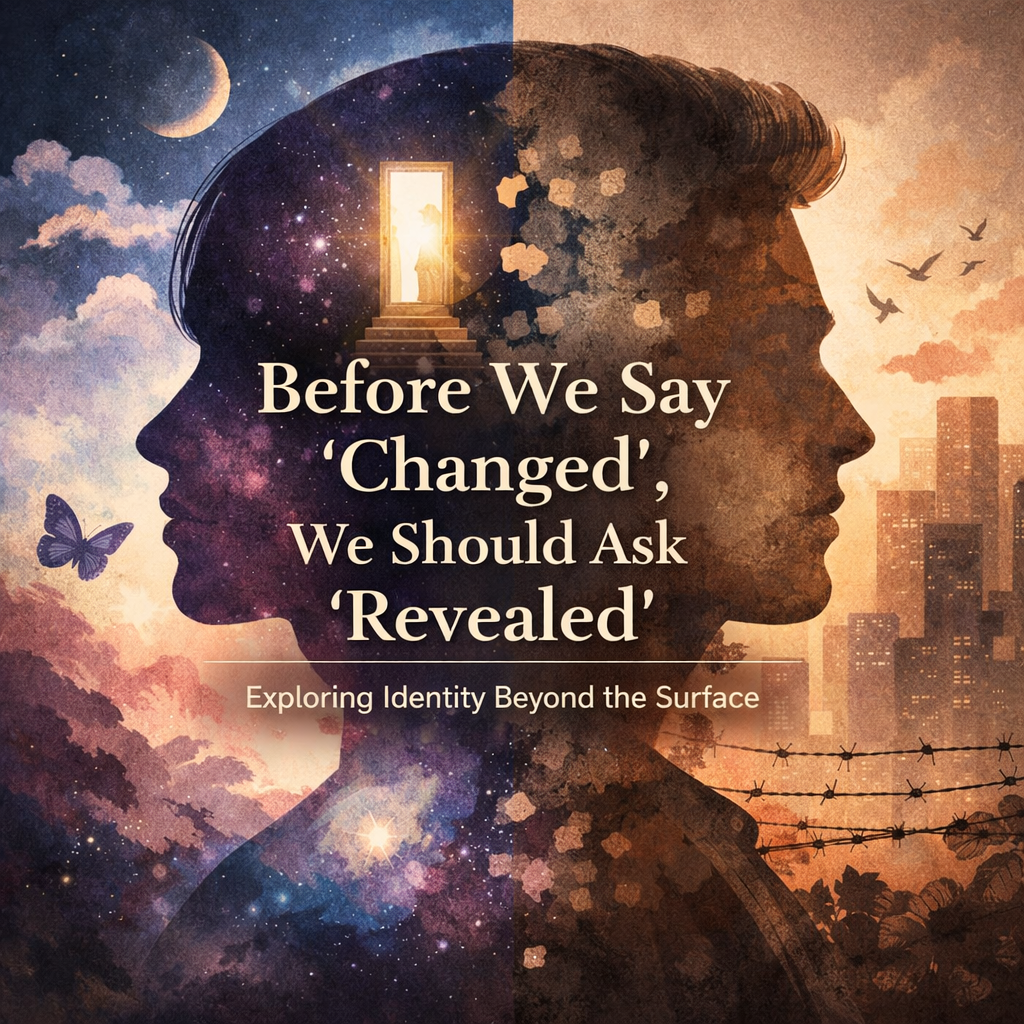
Before We Say ‘Changed’, We Should Ask ‘Revealed’
I was reading an article the other day, a BBC Future piece, about how some people say psychedelic experiences changed the way they see their gender and sexuality. I remember reading it late in the evening, phone in one hand, tea getting cold on the table, and thinking — this sounds dramatic, but something about it feels familiar too.
Not because of psychedelics, but because of people.
Because long before research papers and headlines, I have been sitting across from human beings who are trying to make sense of themselves, often in spaces where they were never really allowed to ask certain questions out loud.
What stayed with me from that article was the word changed. And instinctively, I felt a little resistance to it. In our culture, we already live with enough fear around “badlav” — as if change itself is dangerous, suspicious, something that must be explained or justified.
But identity, at least in my experience, doesn’t usually announce itself like a sudden revolution. It arrives quietly, sometimes clumsily, sometimes half-formed, and often with a lot of confusion attached.
I see this often with younger clients, especially teenagers. They come in speaking with great certainty — “I know who I am,” “This is exactly how I feel,” “This is my truth.” And I listen carefully, because that certainty matters in that moment. Sometimes it stays. Sometimes, with time, safety, and space — something we don’t offer easily in Indian families — that certainty softens, shifts, or grows into something more layered.
And I’ve also sat with adult men, very Indian men, raised with clear ideas of masculinity, who speak softly, gesture gently, express emotion openly — and are often read by the world as “feminine.” Yet when you listen to them closely, there is no confusion inside them. Mentally, physically, emotionally, they are comfortable being men. They are not trying to become anything else. They are simply being themselves.
These moments keep reminding me that expression, identity, and biology are not the same thing — and they don’t always move together. Our society, however, likes neat alignment. It prefers quick labels. It becomes uncomfortable with ambiguity.
Maybe that’s why stories about psychedelics and identity feel so unsettling. They disturb our belief that the self is fixed, finished, and easily explainable.
From what we know, psychedelics may temporarily quiet the inner noise — the constant monitoring, the “log kya kahenge,” the fear of being different — and when that noise drops, even briefly, people sometimes notice feelings they have been pushing aside for years. That noticing can feel like change, even when it is more like recognition.
But I’m careful here. Because I also know that not everyone is helped by intense inner experiences. For some people, especially those carrying old wounds or unspoken trauma, opening the door too suddenly can feel overwhelming. Insight without support can be frightening. And no substance, experience, or label can replace the slow work of understanding oneself over time.
Which brings me back to a simpler thought.
If we allowed people — especially young people — to explore who they are without pressure, without panic, without forcing answers too early… would these discoveries feel so dramatic? Or would they simply feel like a natural part of growing up, growing inward, growing honest?
Maybe what these conversations are really pointing to is not the power of psychedelics, but the lack of gentle spaces in which identity can breathe.
I don’t have conclusions. I don’t think we need them all the time.
But I do feel this strongly — before we rush to say something has changed, it might be worth asking whether something was finally allowed to be seen. And sometimes, that quiet permission is more transformative than anything else.
References / Reading That Sparked This Reflection
- BBC Future – Psychedelics are altering how people see their own gender and sexuality
- Kruger et al. (2025), Journal of Sex Research
- Carhart-Harris et al. (2018) – Psychedelics and self-processing
This is a personal reflection shaped by counselling practice, lived experience, and reading — not a clinical conclusion or instruction.