The Day My Daughter Understood My Motherhood
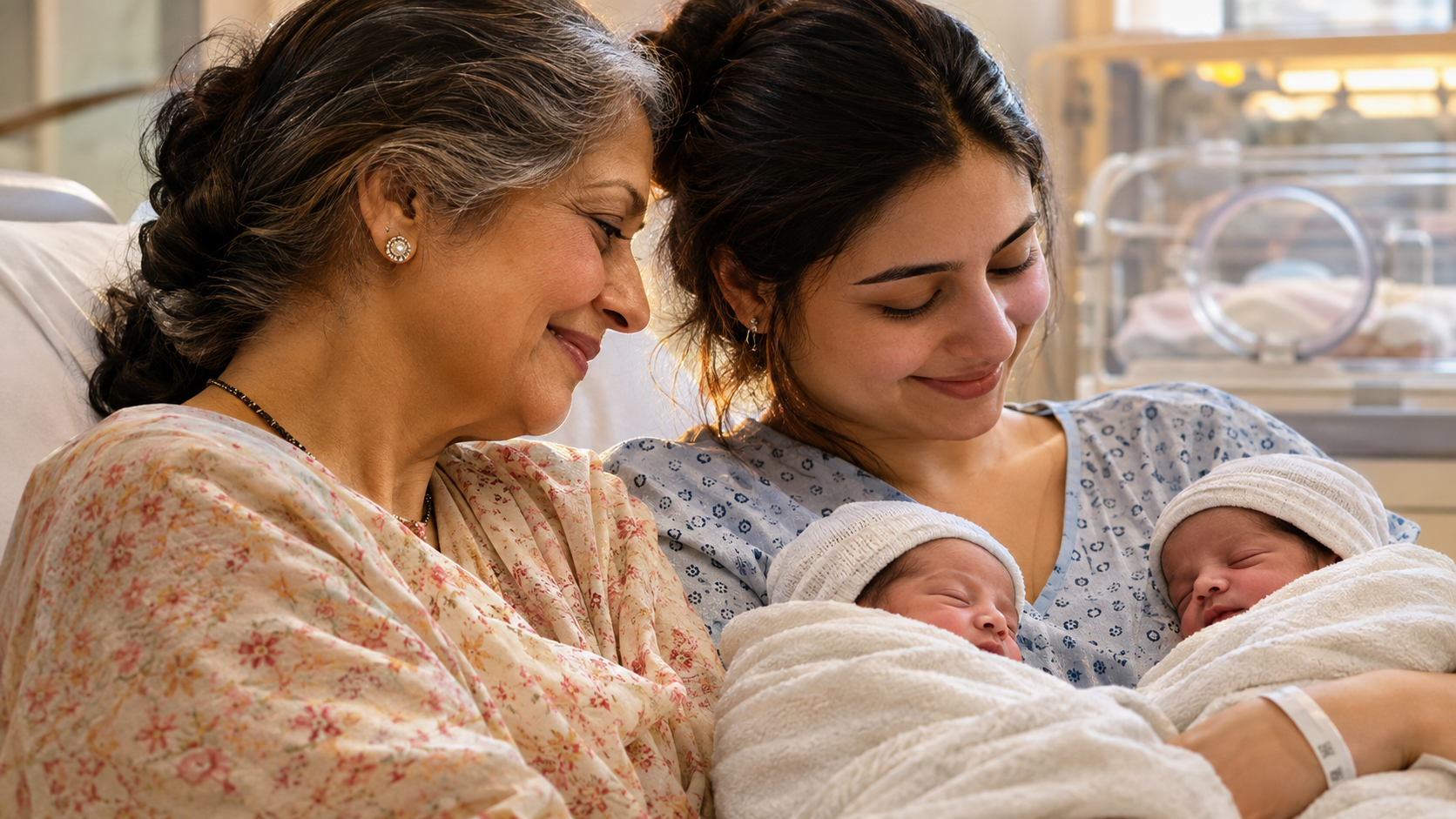
There is something rather amusing about watching your grown-up daughter become a mother. The same girl who once rolled her eyes at your advice, became impatient with your questions and occasionally ended a telephone conversation before you had finished speaking suddenly discovers that loving a child can make even the most sensible woman worry about things she never imagined.
And somewhere, her mother is smiling. Not because she enjoys watching her daughter worry, but because she recognises the feeling.
My daughter recently became a mother to twins. They arrived a little earlier than expected and, although they are doing well, they still need some time under medical supervision. My daughter, meanwhile, is preparing to leave the hospital without them.
She understands why the babies cannot come home yet. They are receiving proper care, making progress, and the doctors understandably do not want to promise a discharge date before they are ready. Everything makes sense medically, but emotions do not always follow medical explanations.
She becomes upset when she thinks about leaving them behind. She wonders whether they will miss her, whether they will be comfortable and whether someone will immediately notice if they need something. She knows they are in experienced hands, yet she wants to be there herself.
One day, while she was telling me how difficult it was to imagine being away from her babies, I couldn’t resist teasing her.
“Now you understand how much a mother loves her children,” I said, laughing. “How worried she becomes, how attached she feels. And then these children grow up, become independent, get irritated with their mothers and sometimes even bang the phone down on them!”
I was only joking, although I must confess there was a little truth hiding behind my laughter.
To my surprise, she became emotional.
“I’m sorry, Mum,” she said, and began to cry.
She told me she had never really thought about how hurt we might feel when our children become impatient with us.
I hadn’t expected that reaction. I certainly wasn’t trying to make her feel guilty. I reassured her that I was only teasing, but later I found myself thinking about what had happened.
My daughter had always known that I loved her. What seemed different that day was that she had begun to understand something about the experience of being the person who does the worrying.
We spend years receiving our mothers’ love without necessarily understanding what it feels like from their side. As children, we know our mothers through what they do for us. They feed us, comfort us, protect us, correct us and occasionally embarrass us in front of our friends. We become so familiar with their concern that we rarely think about the woman experiencing it.
As teenagers, we begin to resist their involvement. As adults, we want them to recognise that we can manage our own lives. Yet mothers sometimes continue expressing affection through the same familiar questions.
“Have you eaten?”
“Yes, Mum.”
“What did you eat?”
“Mum, I’m not a child!”
The poor woman only asked about lunch, but somehow the conversation has turned into a debate about personal freedom.
Of course, mothers are not entirely innocent. We can be repetitive, intrusive and occasionally convinced that our experience qualifies us to advise on subjects about which nobody has asked our opinion. Some mothers could run a very successful consultancy specialising in other people’s lives, provided they could find clients willing to listen.
But there is a psychological reason why these ordinary conversations can become surprisingly emotional.
In a 2009 study published in Psychology and Aging, Kira Birditt, Karen Fingerman and their colleagues examined tensions between parents and adult children across 158 families. They found that tensions involving the relationship itself, including unsolicited advice and frequency of contact, were particularly important to relationship quality.
The researchers discussed intergenerational ambivalence, the coexistence of positive and negative feelings within close family relationships. In simple language, we can love someone enormously and still find them irritating.
A daughter may appreciate her mother’s concern while wishing she would stop asking so many questions. A mother may be proud of her daughter’s independence while feeling hurt when her attempts to remain involved are dismissed. Both may believe they are behaving perfectly reasonably.
The daughter is establishing her independence, while the mother is adjusting to a different form of involvement in her child’s life. What one experiences as care, the other may experience as interference.
This does not mean mothers are always right. Love is not a lifetime licence to supervise another adult. Parents need to respect boundaries, just as adult children can express those boundaries without unnecessary harshness.
Then something interesting happens when a daughter becomes a mother herself. She begins experiencing a different side of attachment, one that involves responsibility for someone who cannot yet explain what they need.
Psychology has a term for the transition into motherhood: matrescence. Introduced by anthropologist Dana Raphael and explored further by psychologist Aurélie Athan, it describes the physical, psychological and social changes involved in becoming a mother.
We celebrate the arrival of a baby, buy tiny clothes, arrange photographs and discuss feeding schedules, but often pay much less attention to the woman who is adjusting to this new identity. She may feel delighted, frightened, confident and helpless within the same afternoon.
There is even a biological dimension to this transformation. In a 2017 study published in Nature Neuroscience, Elseline Hoekzema and her colleagues found that pregnancy was associated with lasting structural changes in areas of the brain involved in social cognition. Some of these changes were associated with measures of maternal attachment after birth.
This does not mean that every mother’s emotions can be explained through brain changes. But it reminds us that motherhood involves more than accepting a new responsibility. It can also involve significant biological and psychological adaptation.
For mothers whose babies need additional hospital care, the emotional adjustment can be particularly difficult. Research on parents of newborns receiving neonatal intensive care has documented substantial levels of anxiety and stress. Medical reassurance is important, but it does not always remove the distress associated with uncertainty and separation.
I see this in my daughter. She knows her babies are safe and receiving the care they need. Yet she still wants to be beside them.
As a counsellor, I find this difference between knowing and feeling particularly important. We often assume that once someone understands a situation, their emotions should settle.
“Don’t worry, everything is fine,” we say.
As though worry is an obedient little creature that will immediately pack its bags because somebody has offered a reasonable explanation.
Unfortunately, it rarely behaves so politely.
Sometimes a person already understands everything we are trying to explain. What they need is someone to listen without repeatedly telling them why they shouldn’t feel the way they do.
While my daughter worries about her babies, I find myself worrying about her. I watch her recovering from childbirth, managing her emotions and preparing for the unfamiliar experience of going home without her children. I want to reassure her, protect her from unnecessary distress and make everything easier.
And then I realise that I am doing exactly what she is doing.
She wants to protect her babies, and I want to protect mine.
The difference is that her babies are newborns, while mine is a grown woman who has just become a mother herself.
It is quite an arrangement. The babies are receiving professional care, their mother is worrying about them, and their grandmother is worrying about their mother. Three generations are involved in the same emotional business, although only two of them are old enough to explain themselves.
But my role is different now. My daughter needs to discover her own confidence and develop her own way of being a mother. My experience may be useful, but it does not make my way the only correct way.
Perhaps that is one of the more difficult lessons of parenting adult children: learning to remain emotionally available without making ourselves responsible for every problem they encounter.
There is another psychological aspect to my daughter’s reaction that interests me even more than maternal worry. It is perspective-taking, the ability to consider another person’s emotional experience rather than seeing a situation only through our own needs and feelings.
For years, my daughter had experienced my concern as the person receiving it. Now, through her own experience of motherhood, she was beginning to imagine what it might have felt like to be the person giving it.
Of course, people do not need to become parents to understand their own mothers. Many develop deep empathy through other experiences, and some mother–daughter relationships are complicated or painful. Parenthood does not automatically make anyone more understanding, nor does maternal love make every parental action acceptable.
But significant experiences can change how we interpret familiar relationships.
That is why I do not see my daughter’s apology as proof that I was right and she was wrong. It would be tempting, of course. After years of explaining things to our children, mothers occasionally enjoy discovering that life has finally supported one of their arguments.
But her tears were not a victory for me.
They were a moment of recognition.
She had begun to understand something about my feelings, and I was reminded that she was experiencing a major transition of her own. She did not need a lecture about maternal sacrifice. She needed her mother to understand that she was frightened of being away from her babies, even while knowing they were safe.
I also know that this moment will not suddenly transform our relationship into one of permanent agreement. I have no doubt that sometime in the future I will ask an unnecessary question at an inconvenient moment, and she will respond with that familiar tone.
And I will probably ask another question anyway.
We are human, after all.
What matters is not whether mothers and daughters stop irritating each other. That would be a rather unrealistic ambition. What matters is whether they can recognise the affection beneath ordinary disagreements without using that affection to excuse hurtful behaviour.
I have been thinking about that conversation ever since. My daughter is waiting to bring her babies home, and I am watching her discover a form of love that is wonderful, demanding and sometimes frightening in its intensity.
For years, my daughter knew that I loved her. That day, while she was talking about her babies, she began to understand a little of what that love had felt like from my side.
And while I watched her becoming a mother, I was reminded that the little girl I once worried about had grown into a woman who now had someone else to worry about.
Neither of us had stopped being a daughter or a mother. We had simply begun to see those roles from another angle.
I suspect we will still have our little disagreements. She may still become impatient, and I may still offer advice nobody requested. But perhaps we will both remember that conversation occasionally and smile.
After all, motherhood does not come with a retirement age, and daughters do not suddenly become saints when they have children.
Fortunately, understanding each other does not require either of those things.
References
- Athan, A. M. (2024). A critical need for the concept of matrescence in perinatal psychiatry. Frontiers in Psychiatry, 15, 1364845. https://doi.org/10.3389/fpsyt.2024.1364845
- Birditt, K. S., Miller, L. M., Fingerman, K. L., & Lefkowitz, E. S. (2009). Tensions in the parent and adult child relationship: Links to solidarity and ambivalence. Psychology and Aging, 24(2), 287–295. https://doi.org/10.1037/a0015196
- Hoekzema, E., et al. (2017). Pregnancy leads to long-lasting changes in human brain structure. Nature Neuroscience, 20, 287–296. https://doi.org/10.1038/nn.4458
- Shetty, A. P., et al. (2024). Prevalence of anxiety, depression, and stress among parents of neonates admitted to neonatal intensive care unit: A systematic review and meta-analysis. Clinical and Experimental Pediatrics, 67(2), 104–115. https://doi.org/10.3345/cep.2023.00486