When Does a Protest Stop Speaking for the People It Began For?
Education has always occupied a special place in my life. I was fortunate to grow up in a family where learning was never seen merely as a means of earning a livelihood but as a responsibility towards society. My father devoted his life to academics, and I myself began my professional journey as a lecturer before life gradually led me towards counselling, writing, community work and the arts. Perhaps that is why, whenever I hear about students losing faith in an examination system, I instinctively think first of the young people and their families rather than the politics surrounding them. Behind every competitive examination lies a story of sacrifice. Parents postpone their own dreams so that their children can pursue theirs. Students spend years preparing for a few crucial hours that they hope will determine the course of their future. When that trust is shaken, the pain is genuine, and it deserves to be acknowledged.
That is precisely why the allegations surrounding the NEET examination disturbed so many people. If an examination is expected to reward merit, every student must have confidence that the process is fair. When questions are raised about that fairness, students have every right to seek answers. No democracy should discourage citizens from demanding transparency or accountability. In fact, the willingness to question institutions is one of the signs of a healthy democracy. None of us should ever lose sight of that principle.
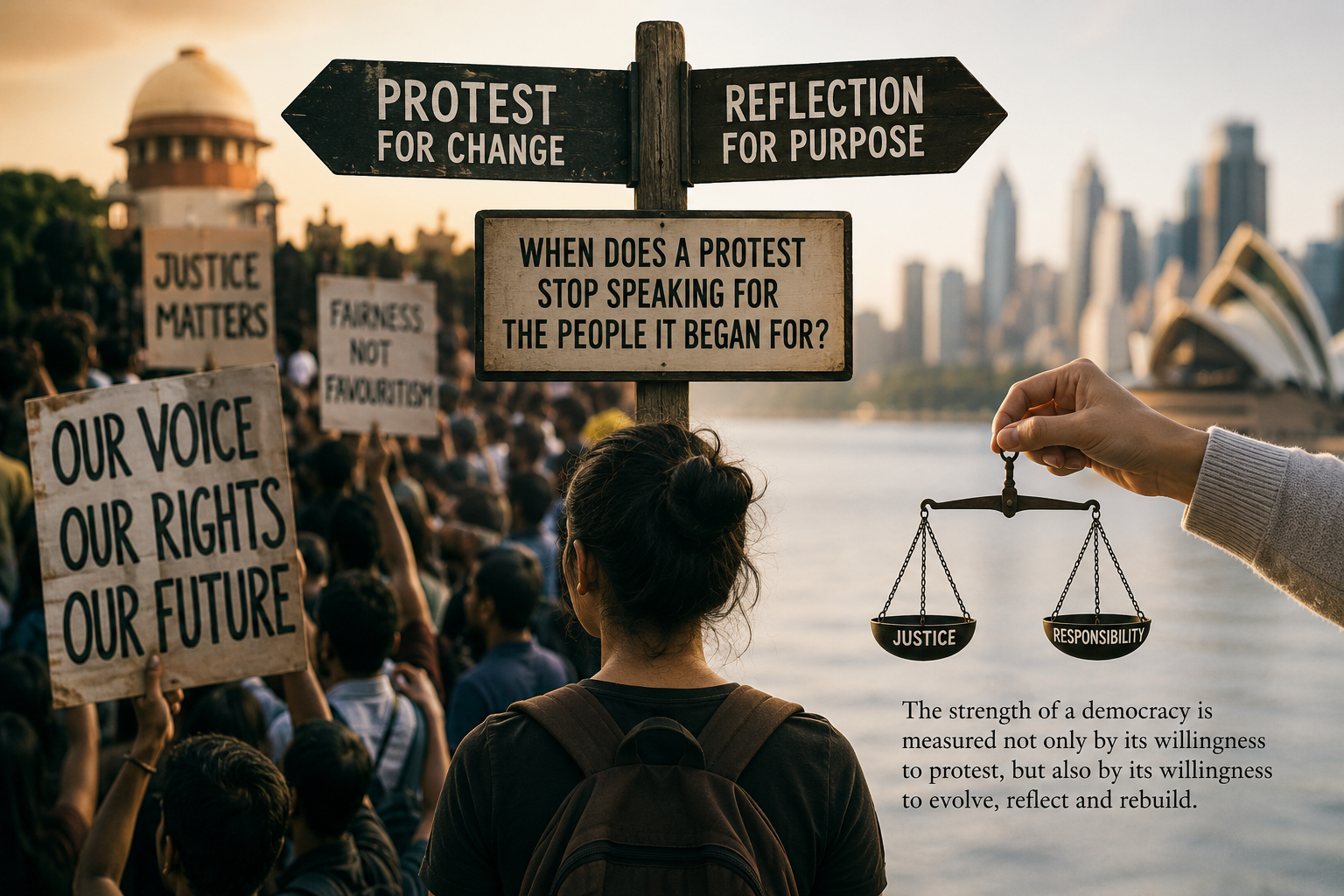
However, another thought has stayed with me over the last two days as I watched videos of protests taking place in Melbourne and Sydney. It was not the protests themselves that made me stop and think. Peaceful protest is a democratic right, and throughout history it has often been the catalyst for necessary change. What stayed with me was something much simpler. I found myself wondering how many of the students, in whose name these demonstrations were being organised, were actually standing there. My instinct told me that most of them were probably doing something entirely different. They were filling out admission forms, discussing colleges with their parents, comparing cut-off marks, arranging accommodation and trying to move on with their lives. Real students rarely have the luxury of remaining in protest forever because their future cannot wait for politics to settle.
As a counsellor, I have learned that there comes a point in every difficult situation when we must ask ourselves a very uncomfortable question. Are we still responding to the original problem, or have we gradually become attached to the conflict itself? Human beings often do this without even realising it. A disagreement begins for one reason, but as emotions build, new issues become attached to it. Gradually, the original purpose becomes blurred. I sometimes wonder whether public movements can go through the same process. They begin with one clear objective, but over time they gather new voices, new emotions and sometimes new agendas until the movement itself becomes larger than the issue that first brought people together.
That was the question I found myself asking while watching those demonstrations from Australia. By now, the investigation into the alleged paper leak had already begun. Arrests had been made. The courts had heard the matter. The admission process was continuing. Whether every decision taken was right or wrong is a debate people will continue to have. My concern lies elsewhere. If the students whose future was affected have already started rebuilding their lives, should we not also ask whether the movement still reflects their immediate concerns, or whether it has slowly become something different?
Living outside India perhaps makes one think about these questions a little differently. Migrants carry two homes in their hearts. We never stop caring about the country where we were born, but we also become conscious of how that country is perceived where we now live. During the past year, Australia has witnessed increasing public debate about immigration. Racist remarks directed towards Indians have become more common across social media, and many members of our community have spoken openly about discrimination they have experienced. Most Indians in Australia are ordinary people who work hard, raise families, contribute to society and quietly build their lives. Yet public opinion is rarely shaped by ordinary lives. It is shaped by what people repeatedly see. A few photographs, a short video or a viral headline can easily become the image through which an entire community is judged.
This is why I experienced a sense of unease while watching India’s internal political conflicts being played out on Australian streets. My discomfort was not because people were expressing their opinions. They have every right to do so. Nor was it because governments should be protected from criticism. Every government, irrespective of political ideology, must remain open to scrutiny. My unease came from wondering whether these demonstrations were still serving the students whose disappointment had originally united everyone, or whether they had gradually become part of a much broader political narrative.
Some may disagree with my perspective, and that is perfectly acceptable. In fact, disagreement is essential in a democracy. What worries me far more is our growing inability to have disagreements without immediately assigning motives to one another. If someone questions the protests, they are accused of supporting the government. If someone supports the protests, they are accused of damaging India’s reputation. Somewhere in between those two extremes, thoughtful conversation disappears. We become so busy deciding who is right that we stop asking what is right.
Counselling has taught me that every conflict eventually reaches a stage where reflection becomes more important than reaction. Expressing anger may be necessary in the beginning, but wisdom lies in recognising when that anger has achieved its purpose and when it risks becoming an end in itself. I believe societies are no different. They need the courage to protest when injustice occurs, but they also need the courage to pause, to reflect and to ask whether continuing in the same way is still helping the very people whose cause first inspired the movement.
The question that has remained with me is therefore much larger than NEET. It is about the maturity of every democratic society. A democracy is strengthened not only by citizens who question authority but also by citizens who are willing to question themselves. Are our actions still helping those in whose name we speak? Have we remembered the people at the centre of the issue, or have they quietly disappeared behind slogans, headlines and political narratives?
I do not claim to have the answers. I simply believe these are questions worth asking. Sometimes the greatest service we can offer any movement is not louder slogans but honest reflection. A movement that remains connected to the people it set out to represent retains its moral strength. The moment that connection begins to weaken, even the noblest cause must have the courage to pause and ask itself where the journey is now leading.
Perhaps that is the conversation we need—not only about NEET, but about every public movement that begins with justice and must work equally hard to remain rooted in it.