
When Did Honest Conversations Become Harder Than Violence?
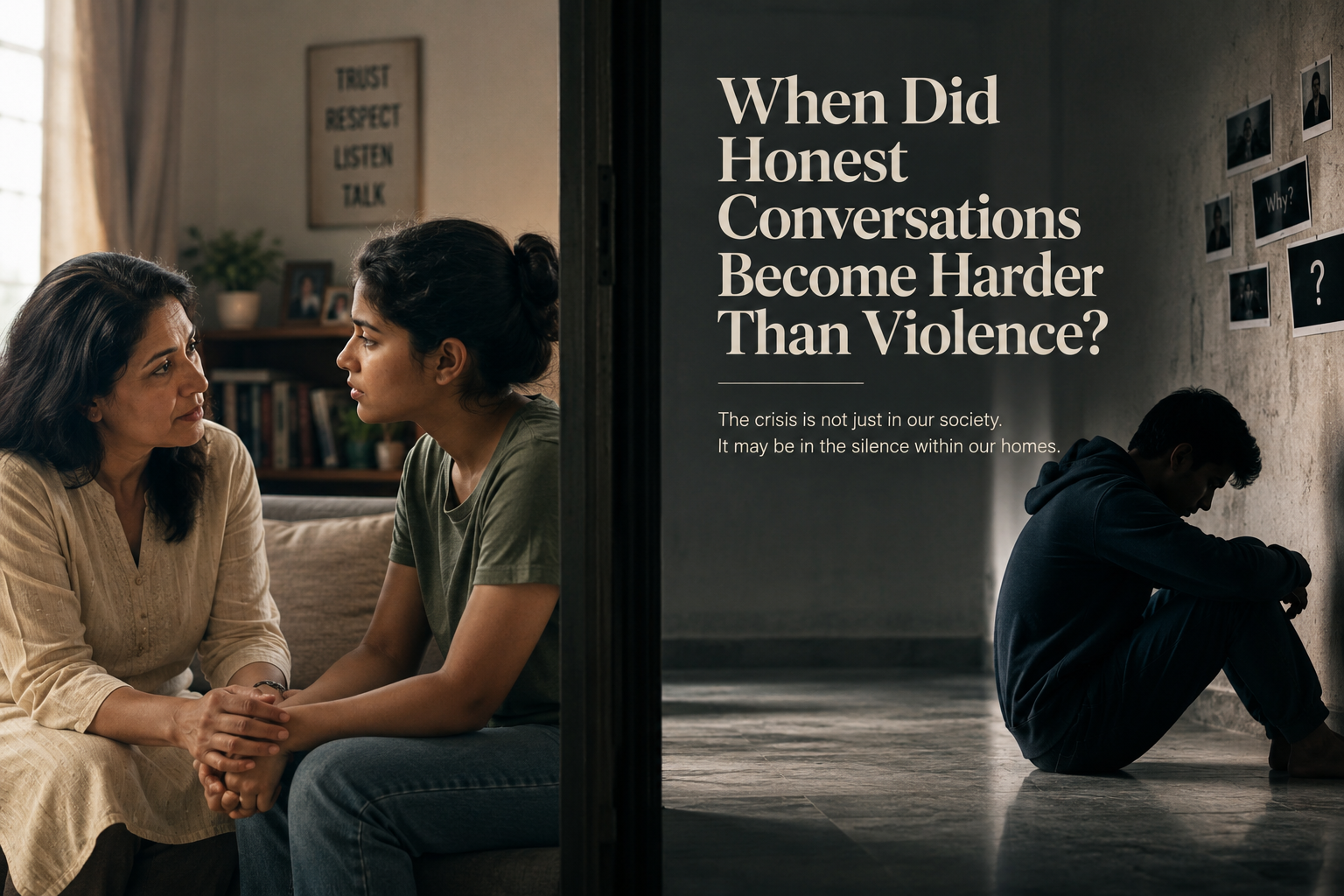
For the last few days, I have been disturbed.
Not because another murder has taken place. Sadly, India has witnessed many such tragedies before. What has unsettled me is something much deeper. Every time I read about another young couple caught in a shocking crime, I find myself asking the same question: How does an educated young person reach a point where ending a human life appears easier than speaking the truth?
I am not writing about one particular case. The courts will decide who is guilty and who is not. My concern is something larger than any individual incident. It is about us—our families, our children and the emotional world we are creating for them.
Perhaps this question troubles me so much because, more than forty years ago, I was also a young woman in love.
I met my husband, in 1983. Whenever I tell our story, people assume that my parents opposed our marriage because I belonged to a Rajput family and he was Punjabi. That explanation is too simplistic. My father was a highly educated man. The real issue was not caste. Like most parents of his generation, he genuinely believed that children, no matter how educated they were, lacked the experience to make such an important decision. I was also the youngest in the family. In my parents’ eyes, I was still their little girl.
Today, as a mother of two daughters, I understand that feeling far better than I did then.
Parents carry a responsibility that children often do not see. They worry about a future that has not yet arrived. They fear pain that has not yet happened. Their intention is usually protection, although sometimes that protection begins to feel like control.
There was no opposition from my husband’s family. The struggle existed entirely on my side. It took almost six years to convince my parents. Those years were filled with conversations, disagreements, tears, persuasion and long periods of silence. My husband patiently met members of my family, answered every difficult question and slowly earned their trust. I also made my position clear. I told my parents that if they could not accept Vikram, I would respect their decision, but I would not marry anyone else.
Looking back after more than three decades of marriage, I realise something that never occurred to me in my twenties. My parents and I wanted the same thing. We all wanted a happy future for me. We simply disagreed about the path that would lead there.
What we never stopped doing was talking. Perhaps that is what worries me most today. Have difficult conversations disappeared from our homes?
Recently, I listened to psychologist Shridhar discussing one of these tragic cases. He made a point that stayed with me. He said parents should not react by becoming detectives—checking phones, reading messages and turning every friendship into an interrogation. I believe he is right. Fear rarely creates honesty. More often, it creates secrecy. Young people who are terrified of disappointing their parents often become experts at hiding the truth.
Psychological research supports this. For decades, studies on parenting have shown that children are more likely to confide in parents who combine warmth with boundaries than in parents who rely only on control or only on freedom. Feeling emotionally safe encourages honesty far more effectively than constant surveillance.
But this is where I would respectfully add something. I do not believe parenting alone explains crimes like these.
If fear of parents were enough to drive someone to murder, our prisons would be overflowing with people from strict families. They are not.
Every year, thousands of engagements are cancelled. Thousands of marriages end in divorce. Millions of people experience rejection, betrayal and heartbreak. They cry, they argue, they seek counselling, they walk away or they begin again. Very few choose violence.
Why?
Because somewhere, despite all the pain, they continue to see the other person as a human being. That is where I believe the real psychological question begins.
Before anyone commits an act of extreme violence, something changes in the way they think. The person standing in front of them slowly stops being a person and starts becoming a problem. Once another human being is reduced to an obstacle standing between “me” and “my happiness,” empathy begins to disappear. Psychology has a name for this process—moral disengagement. It does not excuse crime, but it helps explain how ordinary people sometimes justify extraordinary acts.
This is why I hesitate whenever society rushes to blame only parents, only mobile phones or only modern relationships. Human behaviour is never shaped by one factor alone. Personality, emotional maturity, values, family relationships, peer influence and individual choices all play a part.
At the same time, I also think parents need to ask themselves some uncomfortable questions. Have we confused being a friend with being a parent? Have we become so afraid of upsetting our children that we no longer guide them?
Or have some of us gone to the opposite extreme and created homes where children fear telling the truth? Neither extreme is healthy.
Children do not need parents who monitor every message, nor do they need parents who proudly say, “My child can do whatever they want.” They need something much more difficult to provide. They need parents who will listen without humiliation, guide without domination and remain calm enough that a child can admit a mistake before that mistake grows into a tragedy.
My own mother had no mobile phone, no GPS, no social media and no access to my private life. Yet long before I admitted I was in love, she sensed that something had changed. Today many parents know exactly where their children are every minute of the day, yet have no idea what is happening inside their minds. Somewhere between information and understanding, we seem to have lost something important.
As I look at my own daughters, I know I cannot protect them from every disappointment. I cannot choose every relationship for them or solve every problem they will face. But I hope I have given them one thing—the confidence that no truth is too frightening to bring home.
Perhaps that is the lesson these painful incidents leave us with. Not that we should become more suspicious of our children. Not that we should become more permissive. But that we should build families where honesty is never more frightening than silence.
Because every tragedy does not begin with violence. Sometimes it begins much earlier, on the day a son or daughter decides, “I cannot tell my parents the truth.”
That is the conversation we cannot afford to lose.



Kavita Rana
06/29/2026Your question is so relevant in today’s times. Parenting never comes with a guidebook. Our parenting is guided by our experiences as a child, what we experienced, how our parents brought us up. And we have two pathways- either we do the same as our parents did, if we’re satisfied with it or else we do the opposite if we didn’t like their style of parenting. But the truth is, neither is full proof. Too much strictness creates distance and secrecy while too much liberty leads to aimless and directionless children.
Conversation, specially non- judgemental conversation is the most desired attribute required for good parenting, to build strong, independent thinking individuals
madhvi@mohindra
06/30/2026Thank you for such a thoughtful comment. I completely agree that parenting comes without a manual, and most of us parent either by repeating what we experienced or by consciously trying to avoid it. Both approaches have their strengths and their blind spots.
I also agree that non-judgemental conversation is one of the greatest gifts parents can offer. A child who feels safe to speak is far less likely to carry life’s biggest struggles alone.
At the same time, I believe conversation by itself is not enough. Children also need values, emotional resilience and the ability to cope with disappointment, rejection and conflict. Parents cannot control every choice their children make, but they can help build the character that guides those choices when no one is watching.
Thank you for adding such a valuable perspective to the discussion.