The Courage to Be Wrong

A few days ago, someone asked me for my opinion. I gave it. They looked disappointed.
Not angry. Not offended. Just disappointed.
It took me a while to understand why.
They had not come looking for an opinion at all. They had come looking for agreement.
I have begun to notice this everywhere. In families. In friendships. On television debates. On social media. Even in counselling rooms. People ask questions that sound like invitations to think, but what they are really offering is a small examination paper. There is only one correct answer, and they already know what it is.
The old saying was that truth hurts. I think the new truth is that disagreement hurts even more.
When I was growing up, conversations were often noisy. Uncles argued about politics, aunts debated family matters, grandparents interrupted everyone because they believed experience deserved a hearing. Nobody unfriended anybody. Nobody announced that the family dinner was a toxic environment because two people voted differently or preferred different ways of raising children.
People argued, had tea, and then argued again. Somehow, affection survived disagreement.
Today, we have developed an extraordinary ability to surround ourselves with people who think exactly as we do. Our phones know what we like. Algorithms know what we believe. News channels know what we want to hear. Slowly, without noticing, we begin to mistake repetition for truth.
If a thousand people say the same thing, it must be right. History would advise us to be careful with that assumption. As a counsellor, I have learnt that human beings are not as logical as they believe themselves to be. We protect our beliefs because they protect our identity. Sometimes a person is not defending an opinion. They are defending their entire life story.
A parent does not want to hear that love can sometimes become control. A child does not want to hear that freedom can sometimes become selfishness. A husband does not want to hear that providing financially is not always the same as being emotionally present. A wife does not want to hear that sacrifice can occasionally become a way of controlling others.
None of these truths are comfortable. Yet life is rarely built from comfortable truths. I sometimes think social media has not made us more expressive. It has made us more fragile. We post a thought and immediately count how many people approve of it. A hundred likes feel like wisdom. A hundred disagreements feel like persecution.
We have confused popularity with correctness. Perhaps that is why public conversations have become so exhausting. Every subject is divided into neat little camps. You are expected to choose a side and stay there faithfully. If you change your mind, you are called weak. If you admit uncertainty, you are called uninformed.
The space between two opinions has almost disappeared. And yet, most of life exists exactly there. I have met people who looked successful and were desperately lonely. I have met educated people who behaved foolishly and ordinary people whose wisdom could fill books. I have met those who spoke endlessly about kindness but treated their own families harshly, and I have met quiet people who never discussed morality yet practised it every day.
Human beings are inconvenient. They refuse to fit neatly into categories. Perhaps that is why truth itself has become inconvenient. Truth demands that we occasionally question ourselves. Confirmation asks for no such effort. It wraps itself around us like a comfortable shawl and whispers, “You were right all along.” Who would not prefer that?
The danger, however, is that a society which cannot tolerate disagreement eventually loses the ability to think. It learns only to repeat. The saddest part is that we are teaching this to our children. We tell them to be independent thinkers but become anxious when their independent thinking challenges our own convictions.
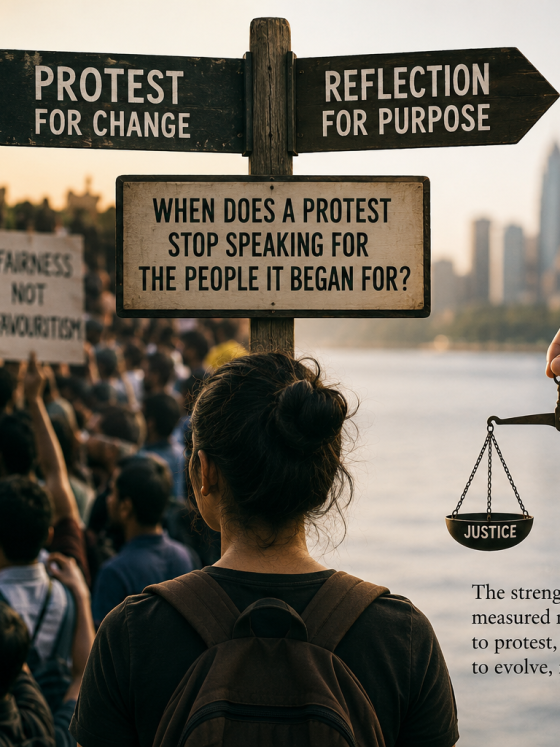
We celebrate courage in history books but punish it in everyday life. I am not arguing that every opinion deserves equal respect. Some ideas are cruel, dishonest or dangerous and must be challenged. But challenge is not the same as cancellation. A conversation is not a war. A different opinion is not a personal attack.
There was a time when changing one’s mind was considered a sign of wisdom. Today, it is often treated as a sign of defeat. Perhaps we have forgotten something very simple. The purpose of a conversation is not always to win it. Sometimes it is to leave it slightly changed. Sometimes the most valuable sentence in any language is not, “I told you so. “It is, “I never thought about it that way.”