
When My Father Turns One Hundred
A Daughter’s Memory After Twenty-Five Years
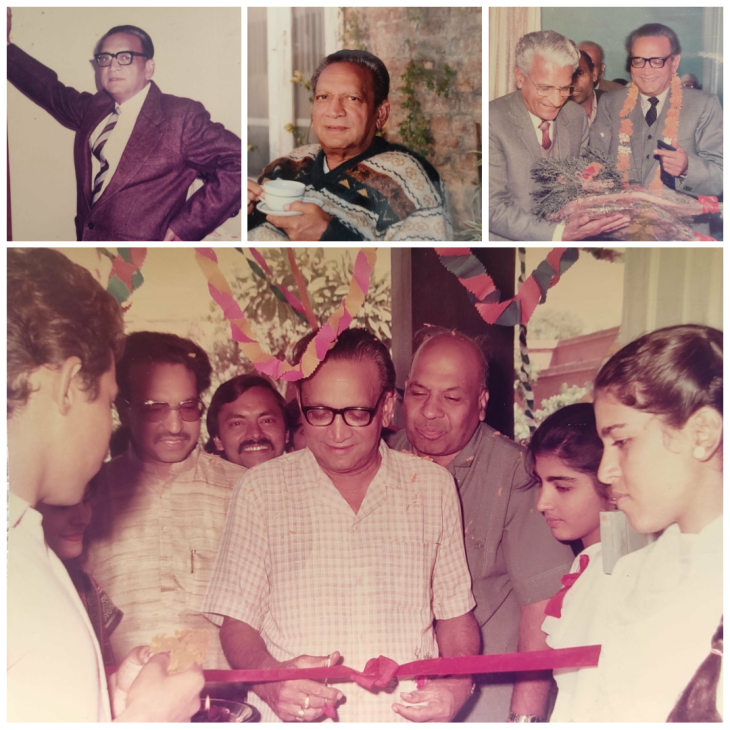
On the tenth of March my father would have turned one hundred. A hundred years is a strange number for a daughter to think about, because time in a family does not move in the same way that history measures it. For the world it becomes a date on a calendar; for a daughter it becomes a quiet return to memories that never completely left.
It has been twenty-five years since he left us in 2001, yet the presence of a parent rarely disappears from life in a simple or final way. People often say that life moves on after such losses, and in practical ways it certainly does. Yet certain voices remain somewhere within us, guiding our choices, questioning our assumptions, and sometimes appearing unexpectedly in the tone of our own thoughts.
To the outside world my father was known through his positions: Professor of English and Psychology, Principal of degree colleges, Dean of Students Welfare, Dean of Colleges, Registrar, and at one point even Acting Vice Chancellor. These titles marked a long academic career and the respect he earned within the world of education.
But for us, his children, he was something both simpler and far more complex at the same time — a strict father, a sharp observer of human nature, a lover of books and cinema, a man with a refined sense of style, and above all a person who quietly shaped six very different lives without ever trying to mould them into one pattern.
A Man Who Read People Like Books
Our house always had books.
Long before the idea of personal libraries became fashionable, my father had already created one of his own. Literature, philosophy, psychology, history, politics — his shelves carried everything that nourishes a thinking mind. Late into the night he would sit reading, sometimes for hours at a stretch.
He was also a writer himself.
He wrote in Hindi, English, and Urdu, moving comfortably between languages, and his literary work earned him the Khwaja Ahmad Abbas Award from the Urdu Sahitya Akademi. Writing was not something separate from his profession; it was simply another way in which his mind engaged with the world.
His sleep was extremely sensitive. The ticking of a clock or the slow dripping of a tap could disturb him, which is why his room was usually set a little apart from the rest of the family. Yet before withdrawing into that quiet space each night he followed a ritual that shaped our childhood more deeply than we understood at the time.
For two or three hours every evening he would sit with the entire family and talk.
Those evenings were our informal university. He spoke about his childhood, his student life, people he had met, strange incidents from his professional world, and often deeply psychological observations about human behaviour. At that age many of those reflections went over our heads, yet they remained stored somewhere in memory.
Today I realise how much we absorbed during those conversations. Even now I sometimes repeat those stories to my own daughters, and occasionally I recognise that the thoughts coming out of my mouth are echoes of his voice.
Perhaps this is how wisdom travels through generations — quietly, through ordinary conversations that later reveal extraordinary meaning.
The Man the World Found Strict
Outside the house my father had a reputation for being extremely strict. Students feared him. Colleagues respected him. Even relatives approached him with a certain seriousness.
At home too we experienced his discipline. If we made mistakes, he scolded us immediately. Yet his strictness always had another side that revealed the tenderness behind it.
If one of us began crying after being reprimanded, the same father who had scolded us would quietly fulfil our request the next day.
His principles were firm, but his heart was deeply soft.
A Literary Gesture on the First Night of Marriage
My mother had studied only up to the eighth class, while my father was already deeply immersed in literature and scholarship. Yet he admired her greatly.
One of the most unusual gestures of his life happened on the very first night after their marriage. My mother’s name before marriage had been Omvati.
That night my father presented her with a copy of Premchand’s Godaan and told her that from that day onward she would be known as Malti, after the heroine of the novel.
Gradually the name became official everywhere.
That simple act revealed something essential about him: he did not merely read literature; he allowed literature to enter his life.
A Rajput Father Who Was Quietly Progressive
We belonged to a traditional Rajput family from Haryana, where customs were deeply respected and social expectations were carefully observed.
My father, however, possessed a mind that was never confined by convention.
My eldest sister Urvashi studied in a co-educational college at a time when many girls were married soon after school. Later she even lived in a hostel to complete her master’s degree in the early 1970s. At university she became the best actor, best speaker, and best athlete.
My brother Shashi Ranjan initially planned to join the civil services, but life changed direction when he applied to the Film and Television Institute in Pune — a bold step for a small-town boy from Haryana in those days. My father supported him completely. Shashi graduated as a gold medalist and today is one of the most respected names in the Indian television industry.
My sister Rita was academically brilliant and exceptionally beautiful. She completed her Master’s degree, M.Ed., and M.Phil., later becoming a writer and painter and even reaching the top finalists of the Femina Miss India competition in 1983. With her my father shared a special intellectual warmth. He recognised early that she lived more in imagination than in routine life, and instead of pushing her toward practicality he allowed her the freedom to remain absorbed in books, ideas, and artistic pursuits. Looking back now, I realise that what we once mistook for preference was actually his way of protecting the temperament of a sensitive and creative child.
My sister Sandhya had a very different personality. She was steady, thoughtful, and quietly responsible. My father trusted her judgment deeply and often treated her almost like a second authority within the household. By giving her responsibility rather than instruction, he strengthened her confidence in ways that perhaps only he understood at the time. She later built a distinguished academic career of her own and eventually retired as principal of a degree college.
Our youngest brother Hemant, being the youngest in the family, naturally received enormous affection. He completed his Master’s degree in psychology and even began his professional life as a lecturer, which in many families would have been considered a secure and respectable path to continue. Yet Hemant carried another passion within him — a deep interest in films and television. Choosing to leave a stable academic career for the uncertainty of the film industry was not a small decision, especially in those days. What remains remarkable to me even today is that my father did not stand in the way of that choice. Despite knowing how unpredictable the film world could be, he allowed Hemant the liberty to follow his own calling and move to Mumbai. In doing so he once again demonstrated something that defined his parenting: he believed that a person’s life should be guided not by fear of uncertainty but by the courage to pursue one’s genuine passion.
Looking back today I realise something important. My father never tried to make all his children the same. Each of us was understood and guided differently according to temperament.
The Daughter He Called “Raunaki Lal”
Among the siblings I was the lively one.
Dancing, laughing, talking, and constantly full of energy, I was the child who could rarely sit still. My father used to call me “Raunaki Lal,” the one who brought brightness wherever she went.
At one point in life I was prepared to sacrifice my love for dance and study psychology instead, believing that would be a more serious academic path.
My father stopped me.
He looked at me and said very simply:
“Tu dance mein sabse achhi hai. Jo tera asli hunar hai, wahi padh.”
Because of that encouragement I completed my degree in Kathak and instrumental music.
Later he encouraged me to pursue a Master’s degree in Hindi, knowing how deeply I loved language and writing. At that time I was already working as a Hindi announcer with All India Radio.
Over the years those influences continued shaping my life. I received Best Dancer awards, participated in Femina Miss India in 1993, completed a PhD in Music Therapy, and even today, in my sixties, I find myself studying again, doing my third master’s degree in counselling.
My writing life also grew from that same foundation. My books Karvatein and Katranei are now published, with more still on the way.
My first book Katranei was dedicated to him on his hundredth birth year and launched in the same university from where he retired and where I completed my education.
Sometimes I feel that my entire life is still in conversation with him.
The Trust That Defined My Life
Perhaps the most important gift my father gave me was trust.
Mine became the first love marriage and the first inter-caste marriage by a daughter in both my father’s and my mother’s extended families. In many Rajput families of Haryana at that time, such decisions were still viewed with hesitation and caution. My father, however, belonged to a different temperament altogether. While he understood the social realities around him, he believed that a daughter’s life should ultimately be guided by trust, judgment, and dignity rather than fear of society.
When my father first came to know about my relationship with Vikram, he did what any thoughtful father might do. He sat with me calmly and tried to reason with me, suggesting that what I was feeling might simply be infatuation and that such decisions should never be taken lightly. His approach was not authoritarian but reflective, almost like a psychologist guiding someone through an important life choice.
Yet what mattered most was what followed that conversation.
Instead of imposing his authority, he chose to trust me and allowed me to make my own decision. Looking back today, I sometimes feel that he had already observed Vikram carefully and had quietly formed his own judgment about the man I had chosen. Perhaps he recognised something that I myself was too young to articulate then.
Life later proved that instinct right.
Vikram became not only my husband but one of the finest companions a woman could hope for. Over the years he has been a partner of integrity, patience, and unwavering support — the kind of husband whose presence turns marriage into a shared journey rather than a social arrangement.
When I think about that moment today, I realise that my father’s trust was not blind permission; it was a decision born out of his ability to read people and to respect the maturity of his daughter.
In a social environment where control would have been easier and far more acceptable, he chose faith instead.
And sometimes I feel that this quiet act of trust was one of the greatest expressions of love a father can offer his daughter.
A Man of Style and Presence
My father loved elegance.
At a time when most people owned very few clothes, he had nearly forty suits and dozens of shirts. He adored perfumes, and a large bottle rarely lasted more than a month.
Our house was inside the university campus, and every morning he would walk to his office as Dean.
Along the route stood the girls’ hostel of the medical college. Later we discovered something amusing: many of the girls would step out onto their balconies simply to watch him pass, impressed by the grace and confidence with which he carried himself.
He was, quite simply, a very handsome man.
Cinema, Exams, and a Fresh Mind
Another great passion of his was cinema.
Whenever a new film received praise in newspapers, he insisted on watching it and often took the entire family along. The curious coincidence was that many of those outings happened just before our exams.
We would hesitate, worried about losing study time.
But he would say with practical wisdom:
“Jo poore saal nahi padha woh 3–4 ghante mein kya kar loge? Chalo film dekh kar dimag fresh karte hain.”
Films like Bobby, Julie, and Satyam Shivam Sundaram therefore became family memories.
The Train Journeys He Loved
My father loved travelling by train.
He believed that if a writer wished to observe real characters, ordinary train compartments offered the richest theatre of human life. Air-conditioned coaches and airplanes, he used to say, often hid people behind social masks.
Years later life created a poignant symmetry. Despite travelling by air many times in later years, my father’s last journey was by train. Two hours after the train began its journey from Delhi, he passed away quietly from heart failure.
The man who loved observing human stories in trains completed his own final chapter there.
The Quiet Trauma I Only Recently Understood
For many years I never realised how deeply that moment had stayed within me.
Whenever my daughters asked to travel by train during visits to India, I always refused.
Only recently did I recognise the truth.
Somewhere deep inside, that last journey had become a silent trauma. Without even noticing it, I had been avoiding trains ever since.
Grief does not always appear in tears; sometimes it hides in the small habits we never question.
A Hundred Years Later
On his hundredth birth anniversary I realise something simple and profound.
My father did not leave monuments or institutions carrying his name.
Instead he left behind six lives shaped by his thinking, and through those lives perhaps many more.
Whenever I dance, write, study, question society, or encourage my daughters to think freely, I recognise the quiet echo of his voice.
A hundred years may sound like a very long time.
Yet inside a daughter’s memory, a father does not grow old. He simply becomes a voice that continues guiding long after the conversation itself has ended.







Vikram Mohindra
03/10/2026Emotions of a Daughter for her Great Father : Simply unmatched
I learnt personally so many thing from my father in law in a very short spam of time after i got married to Madhvi.